Matt Cole
Curiosity drives me, people inspire me, and technology is how I make things happen.
I'm Matt Cole, an engineer, developer, and leader who has spent his career turning complex problems into clear solutions. Whether that's building and leading high-performing engineering teams, designing systems that run on live infrastructure, or helping organisations understand their assets well enough to make better decisions, the thread is always the same: bring the right thinking, build the right things, and leave it better than you found it.
I'm currently looking for my next challenge. I'm drawn to technology leadership roles, but equally at home in asset management and engineering consultancy. If you're building something that needs someone who can think at every level, from strategy to engineering to delivery, I'd like to hear from you.
My Journey
Born
I was born in the UK but grew up in South Africa, returning home in 2000. Arriving felt like a fog lifting. I got a job, enrolled with the Open University, and spent the next decade working full time, raising my daughter, and studying. Graduating with honours was one of the proudest moments of my life.
Education
BSc (Hons) Information Technology and Computing, Open University
What started as a love for building LEGO creations grew into a career of engineering systems that solve real-world problems. That same curiosity and drive to create still fuels everything I do.
One quote that's always resonated with me:
“The first responsibility of a leader is to define reality.”
- 2024
Keolis - Signalling Engineering Manager
Adelaide, Australia - Jul 2024 - Jul 2026
Adelaide was a deliberate choice. Taking on the Signalling Engineering Manager role at Keolis meant relocating to the other side of the world, alone, into one of the most technically complex metropolitan rail environments I had encountered. It was a challenging two years, and ultimately a successful one. The experience also brought something I hadn't expected. Australia is a remarkable country and I have genuine respect for the people I worked with, but it confirmed that the UK is home and Manchester is where I want to build the next chapter. I returned home in July 2026.
I arrived to find four significant challenges waiting and resolved all four, with a team that grew in capability and confidence throughout. In the final months I was appointed by the General Manager to act as Projects and Technical Services Director, leading a 50-person directorate across engineering, asset management, projects, IT, and risk and assurance while covering a period of planned absence.
Signal Engineering was an unstructured function with no career framework and no clear direction. I rebuilt it from the ground up, developing talent in a market where high-calibre technical resources are scarce, and grew a team that is now capable, confident, and continuing to improve. Adelaide Junction, the most critical location on the network, had significant asset condition concerns that required independent scrutiny. I commissioned an independent assessment, built the evidence base, and worked through the right channels to ensure the findings were properly considered. The outcome was a commitment from the relevant stakeholders to address the junction's condition. The Outer Harbor line was ageing and dependent on institutional knowledge that was quietly disappearing. I stabilised it and bought the network meaningful additional life, establishing a technology refresh pathway that gives it the time needed to procure and commission a modern replacement. Condition monitoring had failed four consecutive audits. I designed and implemented the Signalling Assets Condition Assessment Specification, a structured, repeatable framework that moved the network from assumption to evidence in how it understands asset health and remaining life. I also worked with suppliers to design a bespoke mounting bracket that solved a points-machine obsolescence problem which had blocked a renewal for twenty years.
- 2022
Amey - Technical Director
Seconded to Manchester Metrolink - Principal Engineer
Manchester, UK - Jun 2022 - Jul 2024
By 2022 the asset management systems were maturing well and the organisation was beginning to ask the next question: how do we move toward reliability-centred maintenance? A key part of that answer was remote condition monitoring. I was asked to set up a small team to explore what was possible with remote sensors and data, and to start building the evidence base for understanding how assets actually perform in the field.
What followed was two years of hands-on engineering on a live railway network. We built real systems that real engineers used to make real decisions, not prototypes or proof-of-concept work, but production-grade tools that started to change how the organisation understood its assets. It was also a deliberate choice on my part. After years of leading engineering organisations, I wanted to get back to building things, and this was the right opportunity at the right time.
The Points Machine Monitoring system analysed signalling relay logs in real time, calculating transition time averages and standard deviations across every point machine on the network. A result within one standard deviation meant healthy performance. Four or more meant failure was imminent. The maintenance team could act before the network felt it. Spark was a cloud API built on AWS, designed to receive, store and expose telemetry data from edge devices anywhere on the network. Fast to deploy, simple to connect, and built to enable innovation rather than constrain it. The Metrolink Sensor Network ran on top of it. Arduino and ESP32 devices connected via cellular, monitoring track temperatures and cabinet environments in real time. Working versions of both the log file analysis platform and the sensor network, running on replicated data, can be found in the Wonderwall section below. The Tram Movement Correlation System linked the Tram Management System, maintenance database, and sensor network into a unified data platform. The foundation for understanding how the network actually behaves rather than how we assume it does. Not everything landed. The Planning and Access system was well built but the business did not adopt it. That story is worth reading separately in my note section: Great Solutions Can Fail.
- 2020
Amey - Technical Director
Seconded to Manchester Metrolink - Head of Engineering and Asset Management
Manchester - Jan 2020 - Jun 2022
My view has always been that asset management is engineering done right. Not a software system, not a compliance framework imposed from outside, but the discipline of understanding what you own, what it does, how it performs, and what it needs. Taking on Engineering and Asset Management at the UK's largest light rail network meant inheriting a contractual obligation to achieve ISO 55001 accreditation, alongside an organisation that had grown quickly and accumulated a decade of procedural debt along the way. The systems needed to manage the network safely and effectively simply did not exist. That was the starting point.
Over two years I identified, named, and built twelve functional pillars of asset management from scratch, each with its own plan, monitoring, and compliance reporting. Together they gave the organisation clarity, accountability, and a foundation for continuous improvement. ISO 55001 was achieved and asset reliability improved, but the outcome that mattered most was cultural. The organisation began to understand that good asset management is not a burden imposed from outside. That shift in thinking is, in many ways, the hardest thing to achieve and the most valuable.
The 12 Pillars programme touched every corner of the engineering department. Asset information and data governance, document management, configuration management, engineering change control, risk management, maintenance management, condition monitoring, competency management, asset renewals, planning and access, CMMS, and compliance management. Each one built deliberately, connected to the others, and designed to function beyond any one person, team, or franchise. The Asset Risk Management system introduced a structured approach to capturing asset level risks, categorising each one to tolerate, treat, transfer, or terminate. For the first time the organisation could see its risk position clearly. The Trafford Park Line extension was accepted into the maintenance regime during this period. Five and a half kilometres of new infrastructure, six stops, three substations, full OLE and signalling. Every asset registered, every maintenance regime defined. Change management was the hardest part. I wrote a note on exactly this, which you can find in the notes section below: Great Solutions Can Fail.
The measure of a well-built system is that the organisation doesn't need you to keep it running.
- 2018
Amey - Technical Director
Seconded to Manchester Metrolink - Head of Digital, Signalling & Telecommunications (promoted to Technical Director Sep 2019)
Manchester - Mar 2018 - Jan 2020
Signalling is often described as the dark arts. A secretive discipline, traditionally closed to outsiders, where knowledge passes from mentor to apprentice. I was handed leadership of a newly formed Digital, Signalling and Telecommunications team with no signalling background, five organisations worth of people who had never worked together, and a network that was averaging twenty-five service affecting failures every week. Nobody handed me a roadmap. What followed was built on trust, hard work, and a team that rose to the challenge.
Within twelve months service affecting failures dropped from twenty-five per week to two. The team that delivered that improvement went on to keep improving after I moved on. They built the best maintenance schedule on the network, planning heavy maintenance around seasons, avoiding the dead of winter, thinking ahead in a way that had never happened before. I was recently told that in the nine years since the team was formed, three people have left. In a high turnover industry, in a technically demanding discipline, three people in nine years. That says more about what was built than any KPI ever could.
The first job was structure. Five organisations TUPE'd into one, operating to different standards, different contracts, different cultures. I wrote the business case, secured the funding, and built a new organisational model from scratch. A 24/7 roster, north and south teams, a clear division between maintenance and engineering, and a dedicated engineering team focused on assurance and root cause analysis. Looking back, I moved fast and pushed hard. The reorganisation got done and it created something brilliant, but I have not always got the balance right between pace and people, and that reflection has stayed with me. Technical credibility had to be earned. I researched relentlessly, asked questions without embarrassment, and showed genuine care for the people who knew more than me. The team noticed, trust followed, and once the team trusted the leader the rest became possible. The maintenance specifications built during this period gave the department its first structured, evidenced approach to maintaining every system in its care. Better records, better trending, better decisions. The foundation that made everything else possible.
Trust, fairness, and honesty are more important than remuneration packages and benefits. By listening to the team and delivering milestones in the order they wanted, I earned their trust. Everything else followed from that.
- 2016
Amey - Project Director
Manchester - Dec 2016 - Mar 2018
When Amey reorganised, senior people left and a larger London team arrived with an eye on the Manchester operation. Forty professionals were left wondering if they had a future, and I was handed the keys and told to make it work.
We not only survived, we won. Margin grew from 15% to 45% and utilisation averaged 85% month on month. The Manchester team competed directly with their London counterparts, not by being absorbed into them, but by outperforming them. It was the most commercially pressurised environment I had operated in, with big margins, clever people, and a relentless need to win work to keep the team busy. I learned more in those two years than I expected.
Building belief came first. Forty people needed to know their leader was not going anywhere and that the team had a future worth fighting for. Weekly socials, a career path framework, structured personal development, small things that said we are building something here, not winding something down. I stepped out of the delivery pool entirely for a period to focus on winning work, building relationships, and developing the pipeline. Understanding what clients needed before they knew themselves and positioning the team to deliver it. The bid success rate improved and the work came. One of the most significant wins was High Speed 1, the railway connecting London to the Channel Tunnel. The brief was a communications technology refresh and station information systems. We bid for the consultancy rather than the implementation. A deliberate shift in how the team positioned itself. Originally worth £250k the relationship grew to over £1m by the time I left. They are still working together today (2026). The Thames Tideway Tunnel control system had been won before the reorganisation. Thirty million pounds. London's supersewer. A twenty-five kilometre tunnel and a 4.9 billion pound capital investment. We mobilised the team, established the delivery framework, and left it in good hands. They have since delivered it. Eventually I was seconded to Manchester Metrolink. Seven days into the franchise a major failure had brought down the communications network. I led the team that stabilised, restored, and improved resilience in six weeks.
The secondment to Metrolink turned out to be one of the best decisions of my career. Moving into an operational railway environment opened up a completely different way of thinking about engineering, and I knew almost immediately that it was where I wanted to be.
My CV, download it here!
Wonderwall
“These are the systems, tools, and experiments that meant something to the people who used them, and to me while building them.”
A curated set of projects, tools, and experiments that have shaped how I think and build.
Remote Monitoring Through Log File Analysis
Turning raw signalling system logs into early warning intelligence. Built entirely in-house, this remote condition monitoring platform detects deterioration before it becomes failure, shifting maintenance from reactive to predictive. Works alongside the Sensor Network to build a complete picture of asset health.
View →
12 Pillars of Asset Management
A business-critical programme built from scratch to ISO 55001 standards. Twelve interconnected systems covering asset information, risk, maintenance, renewals, and compliance, designed to reduce procedural debt and put engineering decisions on solid ground.
View →
Asset Condition Monitoring
A structured process for understanding what your assets are actually telling you. Competent engineers inspect, grade, and record the real condition of assets in the field, turning subjective observation into objective data that drives renewal planning and risk decisions.
View →
Sensor Network
A technology platform that never sleeps. Sensors deployed across the network continuously monitor temperature, humidity, fan speeds, current, and more, feeding live data into a centralised platform that detects anomalies and flags risk before failure occurs. Works alongside the Log File Analysis platform to build a complete picture of asset health.
View →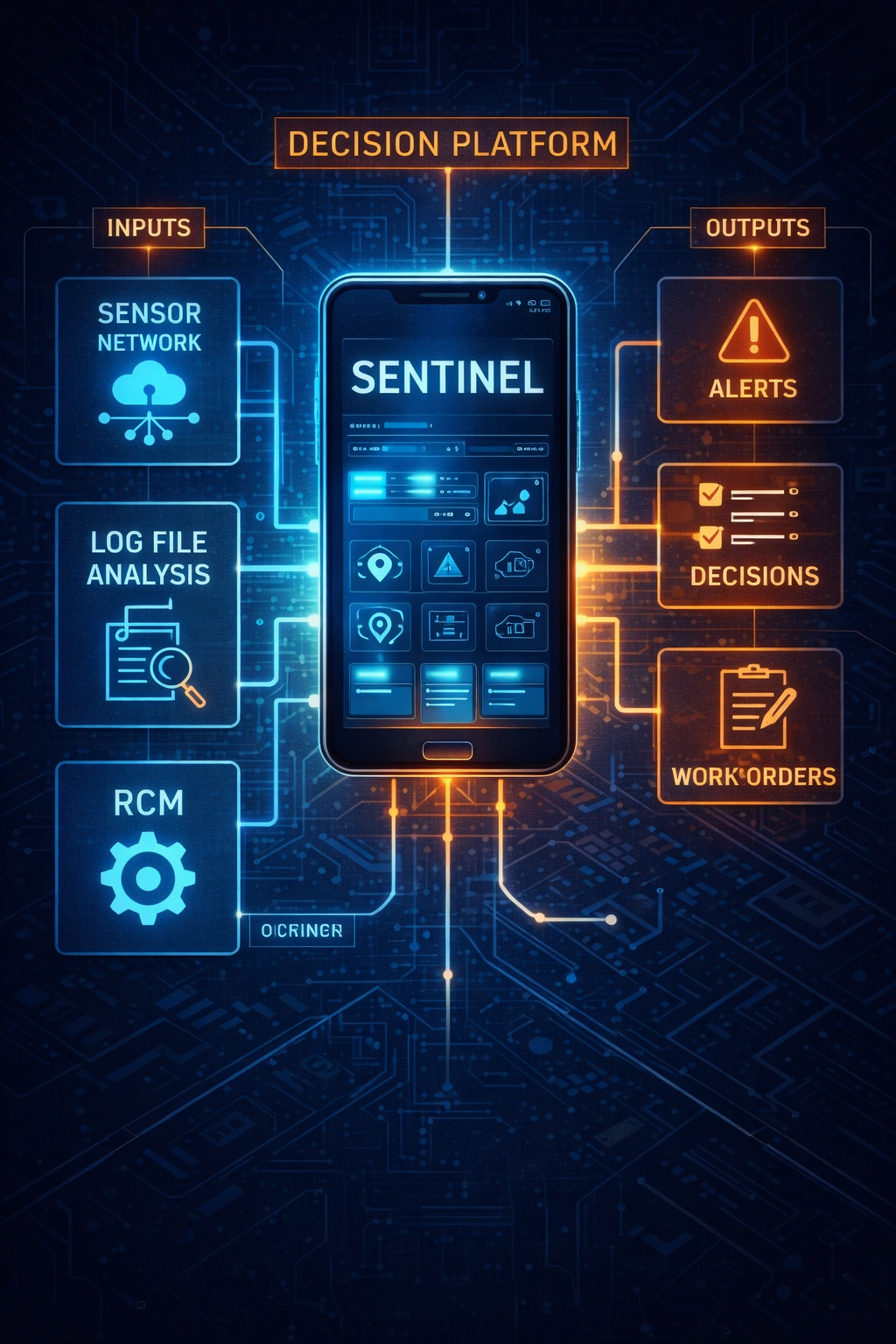
Sentinel
Reliability and asset management reimagined from the ground up. Sentinel is a platform built on graph database architecture and RCM methodology, giving engineers and technicians a conversational, intelligent interface to query complex asset data in real time. Currently in active development.
View →
My Notes
These notes are part sketchpad, part knowledge base. Thoughts that helped me solve problems, explain concepts, or capture systems before they got too complex to hold in my head. If something resonates, feel free to reach out.
Great Solutions Can Fail
A reflection on why great technical solutions and engineering projects often fail. Success depends as much on change management as on the solution itself.
Read Note →You don't know what configuration management is!
True configuration management protects investment, manages risk, and builds confidence in every decision.
Read Note →Bending without breaking
TANCs (Temporary Approvals of Non-Compliance) provide a controlled process to manage and mitigate risks when operations continue in a temporary state of non-compliance
Read Note →Being technically competent is not enough
Competence is not a box to tick but a journey of responsibility and growth. By developing awareness, communication, teamwork, decision making, self-growth, and leadership, engineers turn technical skill into lasting impact. Even experts never stop improving.
Read Note →A Universal Asset Hierarchy you never knew you needed!
A simple, universal framework for organising complex systems. This six-level hierarchy creates structure, traceability, and clarity across any discipline. Order doesn’t have to come at the cost of flexibility.
Read Note →